

When people talk about veterans benefits, the conversation often focuses on programs. But the numbers also tell a much bigger story about how federal dollars flow into our communities.
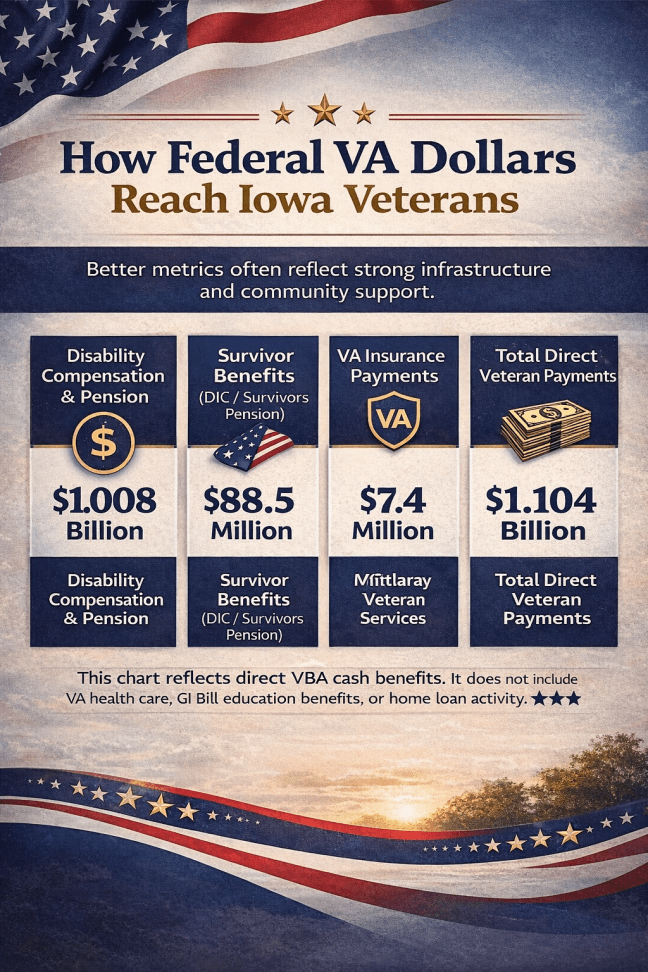
According to the U.S. Department of Veterans Affairs Geographic Distribution of Expenditures report, Iowa veterans receive more than $1.1 billion each year in direct federal payments tied to disability compensation, pension, survivor benefits, and insurance programs (VA, 2024).
Breaking that down:
• $1.008 billion – Disability Compensation & Pension
• $88.5 million – Survivor Benefits (Dependency & Indemnity Compensation / Survivors Pension)
• $7.4 million – VA Insurance Payments
Together, these payments total about $1.104 billion flowing directly to Iowa veterans and their families each year (VA, 2024).
These numbers represent earned benefits tied to military service, but they also represent something else that often goes unnoticed.
They are federal dollars entering local economies.
Veterans use these benefits to support their families, buy homes, pay for healthcare, and spend money in their communities. That means veteran benefits are not only about honoring service. They also help sustain local economies across Iowa.
But when we start comparing counties and looking at performance metrics, another question emerges.
Why do some counties perform better than others?
Often it is not simply about effort. It is about infrastructure.
Counties that show stronger outcomes often have things like:
• More than one full-time Veteran Service Officer
• Accessible offices where veterans can easily get help
• Updated technology to work with VA systems
• Active County Veterans Affairs Commissions
• Strong community advocacy for veterans
In other words, strong metrics often reflect strong infrastructure and support systems.
If the goal is to help every Iowa veteran access the benefits they earned, the real conversation may not be about which counties perform best.
It may be about what conditions help counties succeed — and how we replicate those conditions across the state.
What do you think helps veteran services succeed in a community?
References
U.S. Department of Veterans Affairs. (2024). Geographic Distribution of VA Expenditures (GDX), Fiscal Year 2024. Veteran Population and Expenditure Data.
U.S. Department of Veterans Affairs. (2024). VA Veteran Population and Compensation & Pension Statistics. Retrieved from https://www.va.gov/vetdata/expenditures.asp
 Harvey T. Rimel American Legion Post 141